

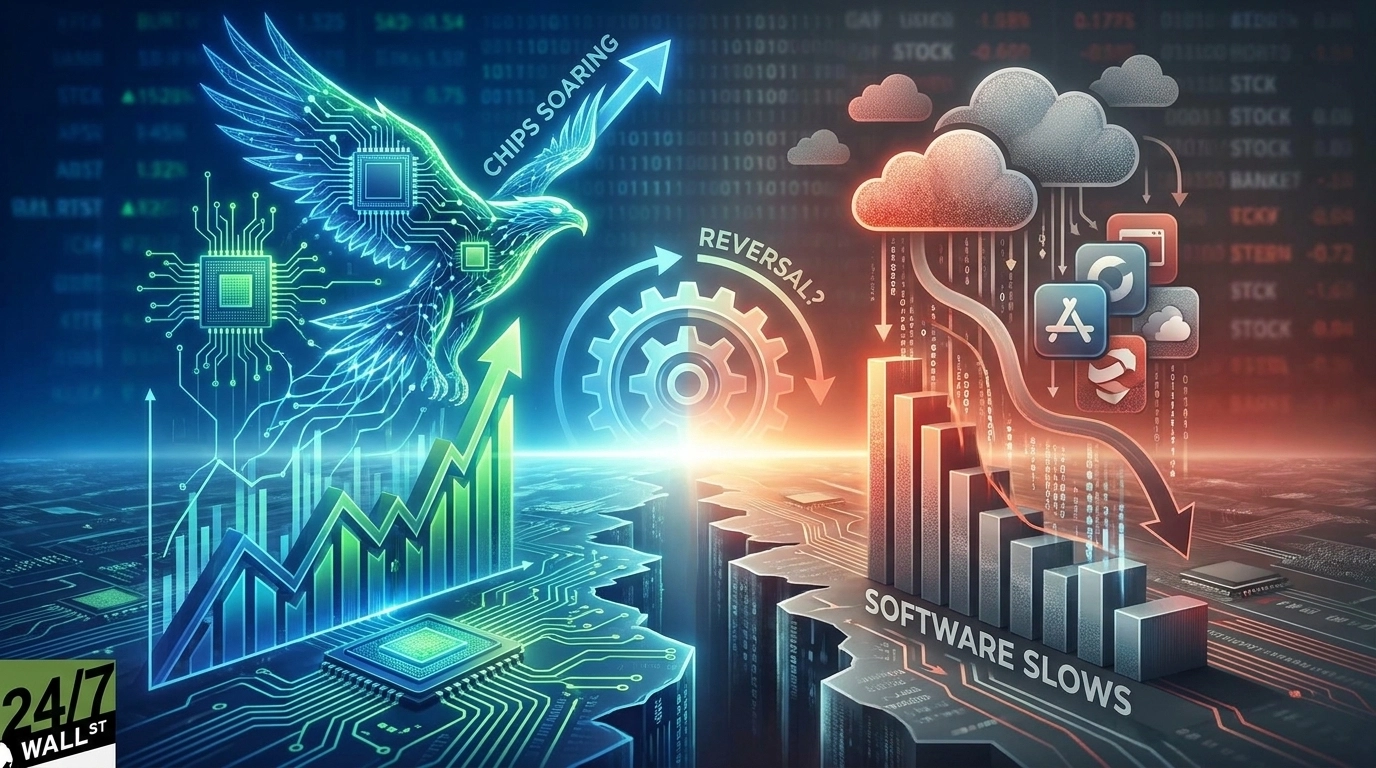
Introduction: Chip Stocks vs. Software Stocks
The ongoing rally in chip stocks, particularly those linked to the development of AI infrastructure, has left software stocks lagging behind. As semiconductor giants like NVIDIA and AMD post record-breaking gains, the software sector—once the backbone of tech growth—has struggled. This divergence has led many investors to question whether a reversal is on the horizon, making the topic of chip stocks versus software stocks highly relevant in today’s market.
The Rise of Chip Stocks
The surge in chip stocks has been nothing short of remarkable. NVIDIA reported a whopping $68.13 billion in revenue for Q4 FY26, marking a 73% year-over-year increase. Its Data Center networking segment soared by 263%, and the company generated free cash flow of $96.58 billion. These eye-popping numbers have driven NVIDIA’s market cap to an unprecedented $5.23 trillion. Similarly, AMD has seen its shares skyrocket by 91% in one month, with Q1 revenue rising 38% to $10.25 billion. The market’s enthusiasm for chip stocks is largely fueled by the insatiable demand for AI infrastructure, as organizations worldwide accelerate digital transformation efforts.
However, these stunning gains come with a caveat: valuations are stretched. AMD trades at a price-to-earnings (P/E) ratio of 141, leaving little room for error. Market sentiment has reached euphoric levels, especially on platforms like Reddit, where retail investors tout huge gains. The question on every investor’s mind: can chip stocks maintain this momentum, or is a correction imminent?
Software Stocks: Underperformance and Value Opportunities
While chip stocks attract headlines and capital, software stocks have stumbled. Salesforce (CRM) has dropped 33% over the past year and trades at just 24x earnings. This is despite strong performance in certain segments, such as Agentforce, which saw annual recurring revenue (ARR) jump 169% to $800 million and 29,000 deals closed in Q4 FY26. Microsoft, another software powerhouse, has also seen its stock decline more than 12% year-to-date, even as its Intelligent Cloud segment grew 30% in Q3 and Azure posted a 40% gain. The AI business is on a $37 billion run rate, up 123% year over year, but increased capital expenditures are raising questions about return on investment.
Some analysts believe this underperformance in software represents a rare value opportunity. With chip stocks pricing in near-perfect execution and software stocks pricing in stagnation, capital could soon rotate back to undervalued platforms with durable revenue streams and emerging AI monetization potential.
Key Players at Risk and Opportunity
Among chip stocks, NVIDIA sits at the center of both the rally and reversal risk. Polymarket traders assign only a 45% chance of NVIDIA hitting $232 in May, indicating skepticism about further short-term gains. AMD faces similar risks due to its high valuation and retail-driven momentum.
On the software side, Salesforce stands out as a potential reversal candidate. The company’s solid fundamentals and insider buying activity suggest meaningful upside if AI software monetization accelerates. Microsoft, bridging both hardware and software, finds itself in a unique position: it benefits from AI infrastructure spending but also faces headwinds if cloud capital expenditures become unsustainable.
Another key name is CyberArk Software, which bridges high-growth software and AI-aligned demand. Currently being acquired by Palo Alto Networks, CyberArk’s focus on identity security and privilege controls for both human and AI identities positions it well for the next phase of software growth. The acquisition structure provides some downside protection, making it a noteworthy player if a sector rotation occurs.
Market Outlook: Is a Rotation Coming?
Market signals hint at rotation rather than a crash. The VIX volatility index is down 28% month over month, and the yield curve remains stable. While chip stocks are priced for flawless execution, software stocks offer cheap valuations, robust recurring revenue, and the potential to benefit as AI monetization catches up. If questions about hyperscaler ROI widen, capital could flow back to platforms like Salesforce and CyberArk, which combine reasonable multiples with durable growth prospects.
However, the risk remains that AI demand continues to grow vertically, allowing chip stocks to consolidate before another leg higher. The current setup suggests investors should prepare for increased volatility and pay close attention to valuation spreads between chip and software stocks.
Conclusion: What Should Investors Watch?
The divergence between chip stocks and software stocks has created a compelling dynamic in the tech market. With chip stocks pricing in perfection and software stocks offering value, a reversal or rotation could be looming. Investors should watch for signs of capital rotation, shifts in AI infrastructure spending, and the ability of software companies to monetize AI advances. In this environment, staying informed and agile is more crucial than ever.
This article is inspired by content from Original Source. It has been rephrased for originality. Images are credited to the original source.