

Hardware or Software Synths: The Great Debate in 2026
Hardware vs software synths—it’s an age-old debate that continues to inspire passionate opinions among music producers and enthusiasts. In 2026, the question is more relevant than ever: with the incredible fidelity of modern software synths, can you really tell the difference between classic hardware and their digital counterparts?
The Evolution of Music Production Technology
Years ago, debates about making music centered on whether a Mac or PC was superior. Today, the landscape has shifted—what matters most is personal taste and workflow. If you’re producing music in a DAW, you likely have access to a range of plugin synths, whether bundled with your DAW, bought separately, or designed to emulate the sound of vintage hardware. With technology advancing so rapidly, the quality of software synths has reached remarkable heights.
But if software synths are so advanced, why do original hardware units remain so expensive? The answer is multi-faceted. Nostalgia plays a part—just like with classic guitars, the first generation of synth enthusiasts cherish the tactile experience of original machines. For some, operating a Minimoog, ARP, Juno, or Jupiter with their own hands is the only way to truly synthesize sound. Purists will argue that nothing matches the authenticity of hardware, especially after investing thousands in a vintage unit.
Hardware vs Software Synths: A Blind Listening Test
Still, is there really something about vintage circuitry that software can’t replicate, or do the drawbacks—like aging components and maintenance needs—give software the edge? With a DAW, loading a soft-synth is quick and intuitive, while vintage hardware can be less convenient to operate. Many companies now offer hybrid solutions, like Roland’s System-8, which bridges both worlds by controlling software through hardware interfaces. Despite these innovations, the allure of classic hardware remains strong for many.
To settle the hardware vs software synths debate, we conducted a blind listening test, comparing three legendary hardware synthesizers with some of the best software emulations available. For each model, we created audio clips using both the original hardware and its software equivalent, keeping the sounds simple and raw—no added EQ, compression, or effects. This allowed for a direct comparison of their sonic qualities.
Test 1: Sequential Circuits Pro-One vs u-he Repro-1
The Sequential Circuits Pro-One, a monophonic powerhouse from the early 1980s, is revered for its punchy filter and creative modulation matrix. We matched it against the u-he Repro-1, a software emulation that has garnered praise for its authenticity. In our test rounds, both synths delivered iconic basses, leads, and riffs. Interestingly, the software held its own, demonstrating that emulations can now rival the originals in both character and versatility.
Test 2: Oberheim Two Voice Pro vs GForce Oberheim TVS Pro
The Oberheim Two Voice Pro is famous for its distinctive SEM filter and onboard sequencer. We compared a 2016 hardware reissue to the GForce Oberheim TVS Pro software, which faithfully reproduces the original’s sound while adding modern enhancements. Through various test patches—octave sweeps, pulsing leads, and chord stabs—the GForce software proved impressively true to the hardware, blurring the lines between analog and digital.
Test 3: Roland Jupiter-8 vs Cherry Audio Mercury-8 vs Roland Jupiter-8 Software
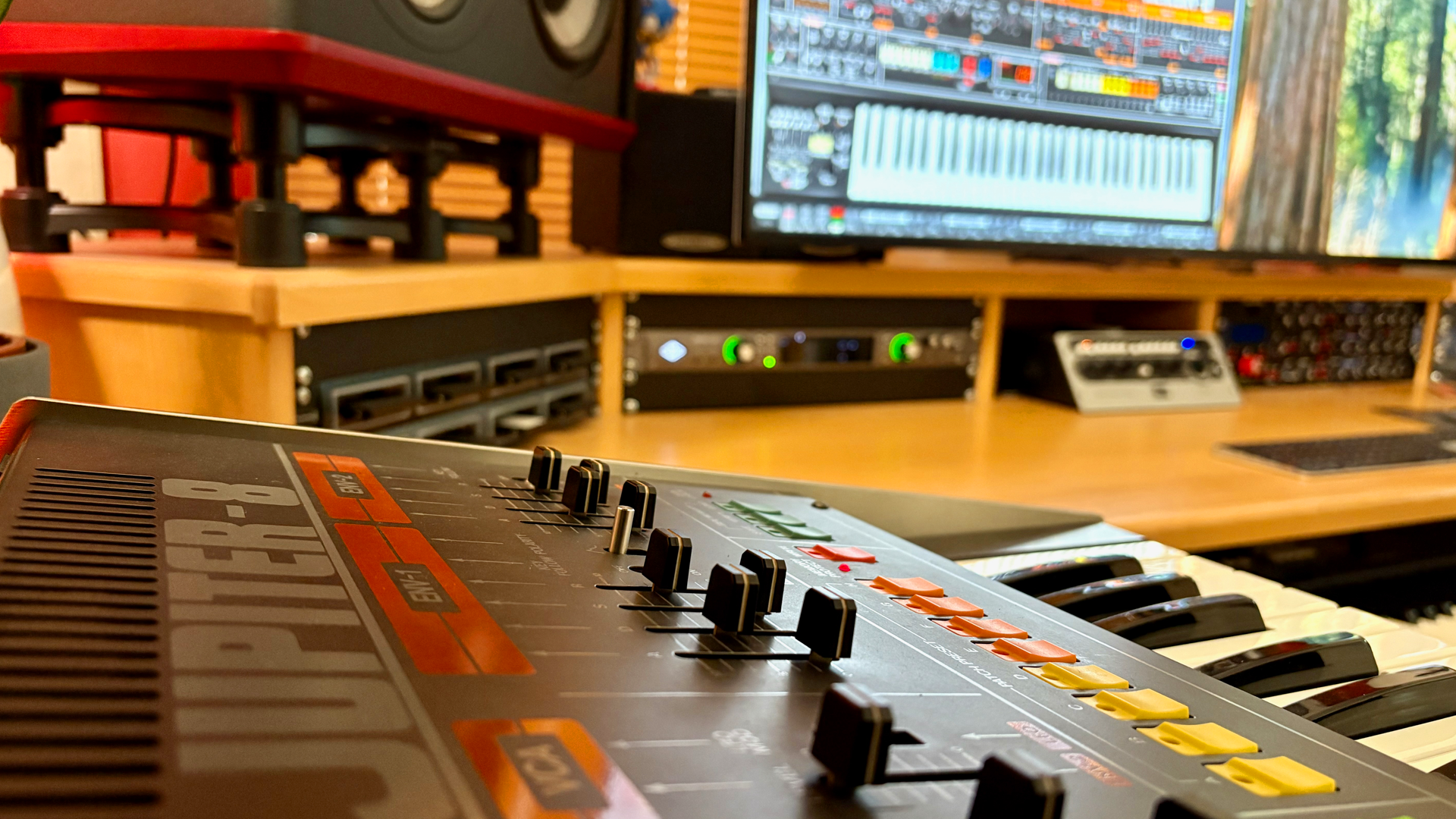
The Roland Jupiter-8 is a true icon, synonymous with the lush sounds of the 1980s. We tested an original unit against two software versions: Roland’s official Jupiter-8 and Cherry Audio’s Mercury-8. Each delivered the classic pads, sweeping leads, and punchy stabs that define the Jupiter-8’s legacy. Again, the differences were subtle—software synths demonstrated astonishing accuracy, with only minor nuances setting them apart from the hardware.
Blind Test Results and Conclusion
After the blind test, even seasoned listeners struggled to consistently differentiate between hardware and software synths. In most cases, the software versions performed exceptionally well, narrowing the gap to the point where preference often comes down to workflow and tactile experience rather than sound quality alone.
While there’s still a unique thrill in manipulating a full-sized synthesizer’s physical controls, the convenience and creative flexibility of software synths are undeniable. As technology continues to evolve, the hardware vs software synths debate will likely shift even further toward personal preference and creative inspiration.
Ultimately, when software can so closely emulate hardware, it’s not about which is objectively better—but about which inspires you to create your best work. Many producers now adopt a hybrid approach, leveraging the strengths of both worlds for maximum flexibility and sonic potential.
This article is inspired by content from Original Source. It has been rephrased for originality. Images are credited to the original source.