

Overview of the CNC Digital Twin Software Market
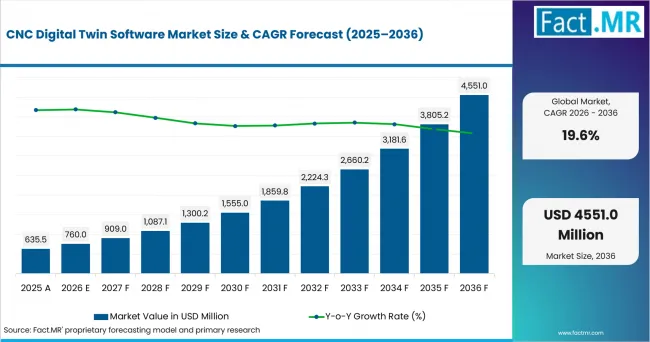
The CNC digital twin software market is experiencing remarkable growth, transforming the way manufacturers validate and optimize machining processes. As industries increasingly adopt digital transformation, the use of digital twin software for CNC machines is becoming critical for achieving precision, efficiency, and reduced operational risks. According to recent market analysis, the CNC digital twin software market is projected to surge from USD 760 million in 2026 to a staggering USD 4,551 million by 2036, reflecting an impressive CAGR of 19.6%.
Market Drivers and Growth Opportunities
Several factors are driving the rapid expansion of the CNC digital twin software market. One of the primary drivers is the demand for machine-level simulation. CNC programmers and manufacturers seek advanced simulation tools to prevent costly setup errors, especially in industries like aerospace where high-value workpieces and tight tolerances make traditional trial-and-error methods expensive and inefficient.
Cloud/SaaS deployment models are leading the charge, expected to capture 57.0% market share in 2026. These solutions offer shared machine libraries and centralized simulation workflows, making collaboration across engineering teams seamless while reducing the need for local infrastructure. Machining simulation—projected to represent 32.0% share—remains the top capability, enabling shops to validate toolpaths and machine motions virtually before production begins.
Industry Segmentation and Regional Insights
The CNC digital twin software market is segmented by deployment, capability, end-use industry, and machine type. Aerospace is anticipated to lead end-use industries with a 28.0% market share in 2026, a testament to the sector’s reliance on digital prove-out for complex, high-value parts. Milling centres are forecast to represent 41.0% of the machine type segment, reflecting their broad application across automotive, aerospace, and general manufacturing.
Geographically, South Korea is set to lead the market with a CAGR of 21.6%, fueled by smart-manufacturing investments and a robust electronics sector. The United States follows closely at 21.1%, leveraging its strong industrial base and aerospace machining expertise. Other key growth regions include the United Kingdom, France, Germany, and Japan, all benefitting from manufacturing digitalization and automation initiatives.
Key Players and Competitive Landscape
Leading companies in the CNC digital twin software market include Siemens, Hexagon, Dassault Systèmes, CGTECH (VERICUT), Autodesk, and Synopsys (Ansys). Siemens offers robust digital twin capabilities through its NX CAM platform, while Hexagon’s ESPRIT EDGE and NCSIMUL solutions provide advanced programming, G-code verification, and machine simulation. Autodesk’s Fusion CAM supports machine-tool simulation for more accurate setup, and Dassault Systèmes partners with NVIDIA to integrate AI infrastructure into virtual twin technologies.
Trends Shaping the Future of CNC Digital Twin Software
Technological advancements continue to shape the CNC digital twin software market. AI-assisted programming, multi-axis machine library depth, and training simulations are emerging as significant opportunities. The rise of SaaS solutions for job shops is lowering barriers for smaller manufacturers, while virtual commissioning and predictive maintenance capabilities are becoming standard requirements.
However, several challenges remain. Model-library gaps, particularly with older CNC machines, can hinder simulation reliability. Concerns about sensitive production data limit cloud adoption in defense and aerospace sectors, and the learning curve for maintaining virtual models can be steep for less experienced programmers.
Market Outlook and Strategic Implications
The outlook for the CNC digital twin software market is highly positive. As more manufacturers invest in digital transformation, the value of accurate, controller-aware simulation and virtual commissioning becomes increasingly apparent. Vendors are encouraged to strengthen their machine-library offerings and demonstrate proof that digital twins can reduce rework and scrap. For machine-tool builders, bundling digital models with equipment can accelerate customer acceptance and streamline setup processes.
Investors and decision-makers should note that success in this market hinges on supporting diverse machine kinematics, controller versions, and secure data management. As cloud-based and AI-driven solutions mature, the CNC digital twin software market is set to play a pivotal role in the future of precision manufacturing worldwide.
This article is inspired by content from Original Source. It has been rephrased for originality. Images are credited to the original source.