
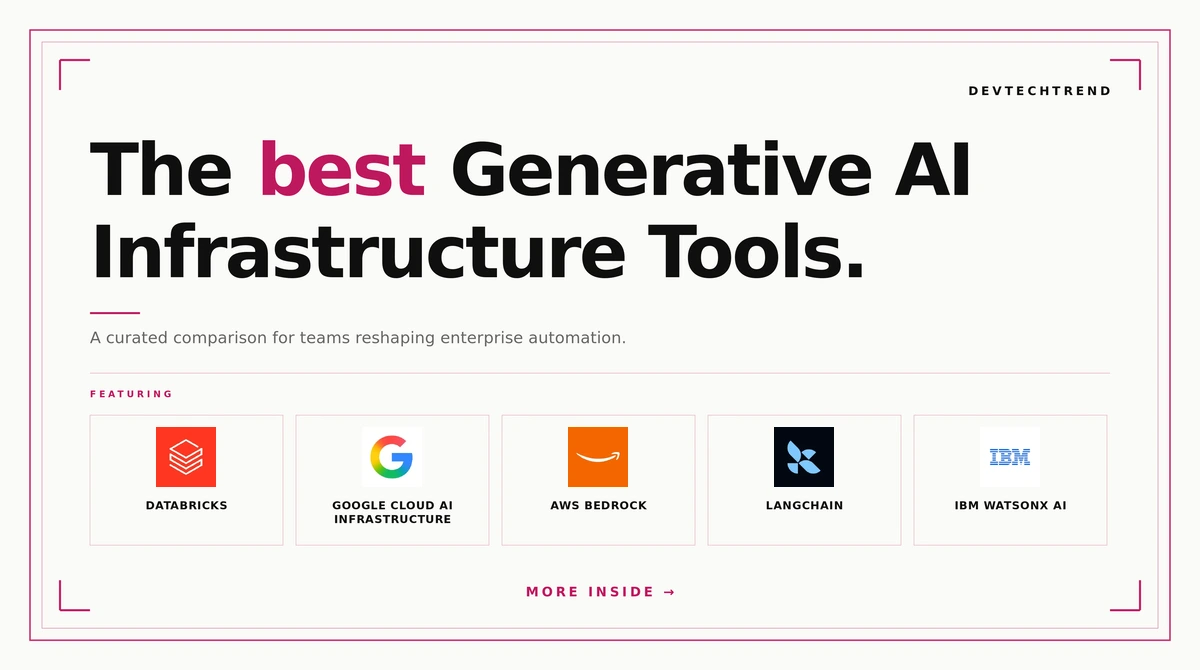
The generative AI infrastructure market has matured dramatically, and teams choosing the right platform now can accelerate their path to production. In 2026, we’re seeing clear separation between platforms that force teams to duct-tape solutions together and those that provide genuine end-to-end orchestration. What matters most isn’t raw compute power-it’s reliability, governance, and cost discipline in the messy work of running models at scale.
We’ve evaluated the leading generative AI infrastructure tools to identify which ones actually deliver on their promises. The category is crowded, but the winners share a common thread: they make it simple to move from experimentation to production without requiring teams to rebuild their entire workflow midway through.
How We Picked
Our selection focused on tools that have proven themselves in real production environments. We weighted factors including deployment simplicity, observability depth, cost transparency, governance capabilities, and whether teams can actually iterate fast without hitting operational walls. We prioritized tools that reduce friction for ML engineers and data scientists alike, not just marketing buzzwords.
 | 1. Databricks |
Website: https://www.databricks.com
Databricks is the rare platform that unifies data engineering, analytics, and AI into one governed environment. The standout is its lakehouse architecture-teams run SQL analytics, build data pipelines, and train generative AI models without data silos or moving data between systems. For organizations drowning in fragmented tools, this consolidation alone saves months of engineering effort. The platform handles both structured and unstructured data seamlessly, which matters when fine-tuning language models on proprietary documents or logs.
Content Capabilities:
- End-to-end ML and generative AI orchestration
- Unified lakehouse with SQL, Delta Lake, and Unity Catalog governance
- Fine-tuning and model serving within the same platform
- Real-time data pipelines for inference workflows
Best for: Enterprises with fragmented data stacks who need to unify analytics and AI under one roof without vendor lock-in.
 | 2. Google Cloud AI Infrastructure |
Website: https://cloud.google.com/ai
Google’s infrastructure plays to its core strength: TPUs. If your workload is matrix multiplication at scale, nothing beats TPU performance-per-dollar. The platform integrates with Vertex AI for end-to-end workflows, and teams appreciate the transparent pricing model. Where it shines is for organizations already committed to Google Cloud-the integration with BigQuery, Cloud Storage, and Kubernetes is genuinely smooth. Documentation is thorough, and the community is active. The learning curve is steep for newcomers, but once mastered, the platform scales reliably.
Content Capabilities:
- High-performance GPU and TPU compute options
- Seamless integration with BigQuery and Cloud Storage
- Flexible deployment across cloud and hybrid environments
- Advanced monitoring and cost forecasting tools
Best for: Organizations deeply invested in Google Cloud who need predictable inference at scale with top-tier hardware.
 | 3. AWS Bedrock |
Website: https://aws.amazon.com/bedrock
AWS Bedrock strips away infrastructure friction by giving developers a unified API to multiple foundation models from different providers. This is particularly valuable for teams experimenting with model selection-you can test Claude, Mistral, and Amazon’s Titan side-by-side without rewriting integration code. The agentcore feature for building autonomous systems is genuinely thoughtful. Cost remains opaque until workloads scale, and regional availability is still limited, but for teams already living inside AWS, Bedrock is the natural choice.
Content Capabilities:
- Multi-provider foundation model access via unified API
- Agent development and orchestration tools
- Knowledge bases for RAG implementations
- Built-in safety guardrails and compliance features
Best for: AWS-native teams who want to experiment with multiple foundation models without vendor lock-in at the model layer.
 | 4. Langchain |
Website: https://www.langchain.com
Langchain is the developer framework that lets you build sophisticated AI applications without reinventing the wheel. Over 1,000 integrations mean your LLM orchestration logic can connect to virtually any data source or API. The modular architecture is refreshingly flexible-you pick components that fit your use case rather than being forced into a rigid stack. Documentation has improved significantly, and the community contribution rate is exceptional. The learning curve is real, but the payoff is a codebase that ages better than monolithic frameworks.
Content Capabilities:
- 1,000+ integrations across models, tools, and databases
- Memory management for stateful AI interactions
- Agent framework for autonomous task execution
- Durable runtime with checkpointing and human-in-the-loop
Best for: Development teams who want maximum flexibility to build custom generative AI applications without being locked into a single vendor’s ecosystem.
 | 5. IBM watsonx.ai |
Website: https://www.ibm.com/watsonx
IBM watsonx.ai is the enterprise play-built from day one for regulated industries and teams with complex governance needs. The integrated studio brings prompt tuning, model evaluation, and deployment workflows into one environment, which appeals to Fortune 500 companies that refuse to stitch together open-source components. Integration with IBM’s middleware stack is seamless. Setup is complex, pricing is opaque until negotiation, and it’s not designed for scrappy startups. But for established enterprises with compliance officers breathing down their necks, the governance layer is genuinely valuable.
Content Capabilities:
- Enterprise-grade governance and compliance controls
- Integrated prompt tuning and model evaluation
- Fine-tuning capabilities with proprietary data
- Seamless IBM middleware and legacy system integration
Best for: Fortune 500 enterprises and regulated industries where governance, compliance, and integration with legacy IBM systems are non-negotiable.
 | 6. Dataiku |
Website: https://www.dataiku.com
Dataiku takes the opposite approach to Langchain-instead of maximum flexibility, it emphasizes low-code visual workflows. Data scientists and business analysts can build generative AI pipelines without writing much code, which democratizes AI deployment across larger organizations. The platform handles the full lifecycle: feature engineering, model training, deployment, monitoring, and governance all in one visual interface. The learning curve is gentler than pure infrastructure tools, and teams appreciate the built-in collaboration features. It’s more opinionated than some alternatives, but that opinion serves production reliability well.
Content Capabilities:
- Low-code visual workflow builder for ML and AI
- End-to-end pipeline orchestration and governance
- Real-time monitoring and performance tracking
- Seamless integrations with data warehouses and cloud platforms
Best for: Organizations with data scientists and analysts of varying technical backgrounds who need to ship production AI pipelines fast without deep coding expertise.
Final Thoughts on Generative AI Infrastructure Tools
Choosing a generative AI infrastructure platform is fundamentally a choice about operational philosophy. Do you want maximum flexibility and code control, or are you willing to trade some flexibility for governance and ease-of-use? Do you need multi-cloud portability, or are you all-in on a single cloud provider? The winners in 2026 aren’t trying to be everything-they’re deeply committing to a specific operational model and executing brilliantly within that scope. Pick the one that aligns with your team’s strengths and production requirements, not the one with the most features.
Manage Your Way Into Coverage
If you’re building a generative AI infrastructure tool or platform, document your real customer outcomes. Feature lists matter less than production metrics: inference latency, cost per request, time-to-production, and operational reliability. Build in public, share what works and what breaks, and let the market decide.
Frequently Asked Questions
What is generative AI infrastructure software?
Generative AI infrastructure software provides the systems needed to build and run generative models in production, covering compute management (GPUs, TPUs), model deployment, orchestration, monitoring, and governance to keep models reliable and cost-controlled.
How much does generative AI infrastructure cost?
Most generative AI infrastructure platforms use usage-based pricing tied to GPU hours, inference volume, storage, and advanced features. Enterprise contracts vary widely, but expect $100-$10,000+ monthly depending on workload scale and governance requirements.
Is there free generative AI infrastructure software?
Yes, platforms like Langchain and some open-source frameworks are free, though they require you to manage your own compute. AWS, Google Cloud, and Databricks offer free tiers and trials, making experimentation accessible before committing to paid plans.
How do I choose the best generative AI infrastructure tool?
Start with your production requirements: which models you’ll serve, expected traffic volume, latency goals, and governance needs. Evaluate deployment simplicity, cost transparency, security controls, and whether the platform supports both experimentation and production operations.